Tags
News
Published
Ready to activate your content? Talk to our team.
Every year, MAD//Fest picks a theme that runs through the whole event. Manchester got "Northern Soul." London got "The Human Touch." Different cities, different energy, but underneath both was the same idea: the best events are made by the people in the room, not just the people on stage.
We partnered with MAD//Fest across both events this year to help bring that idea to life, not just in the programming, but in the screens, the content, and everything happening around the venue. Here's what we built, what we learned, and what surprised us along the way.
When screens reflect the room, people pay attention
At most conferences and festivals, the screens between sessions are dead space. A holding slide. A sponsor logo on rotation. Something you glance at, then immediately forget.
Which is a shame, because screens are one of the only things in a venue that everyone looks at. Show people what's actually happening in the room right now, and suddenly that screen isn't wallpaper anymore. It's something people want to look at and engage with.
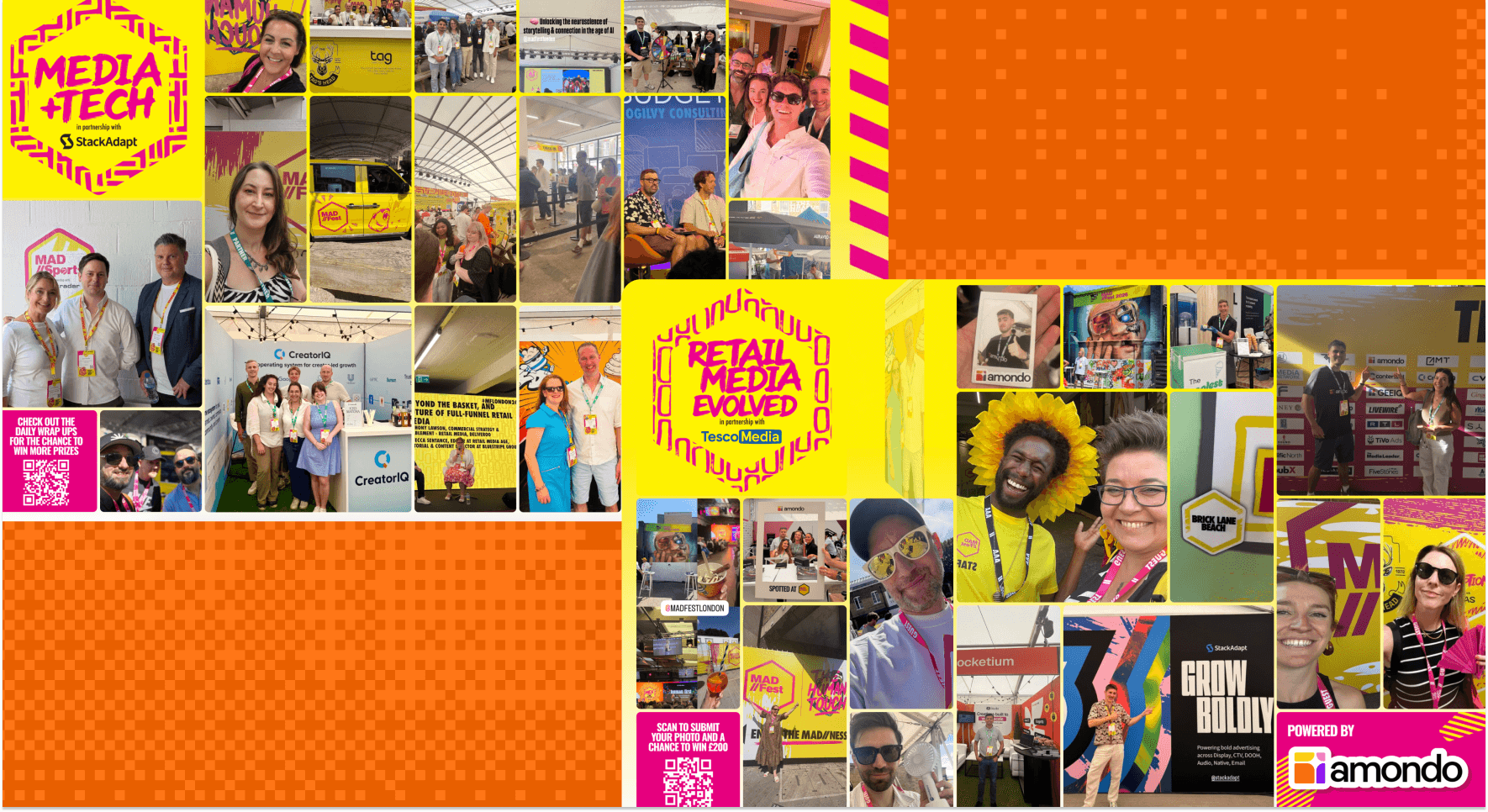
Across both MAD//North at Aviva Studios and all eight stages at MAD//Fest London in the Truman Brewery, we ran our Display solution showing real attendee content in real time: photos, videos, social posts from the day, all curated and moderated by our team behind the scenes. When people looked up between talks, they saw themselves and their peers. Not a placeholder.
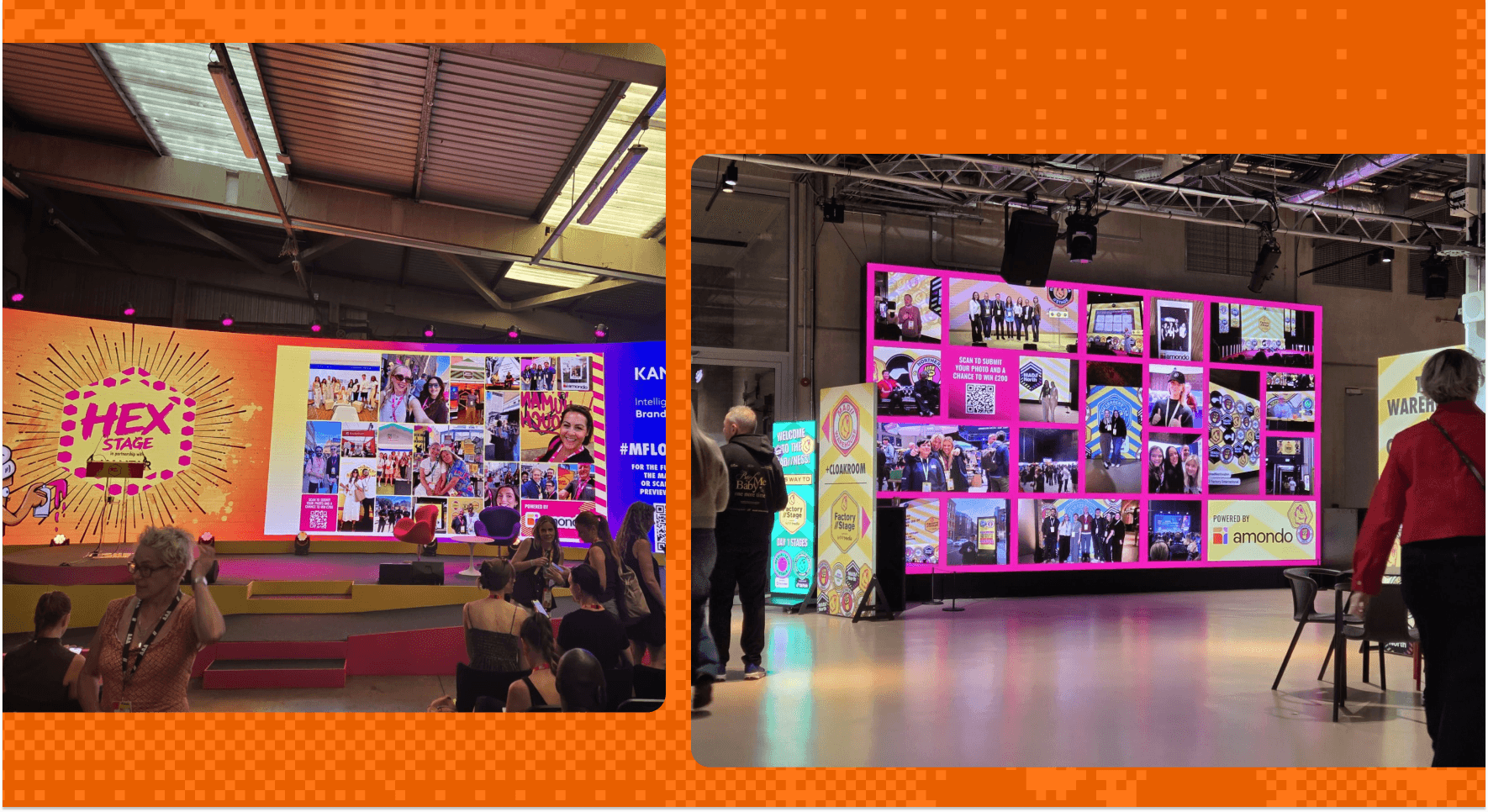
And that's where it gets interesting. Someone spots themselves on screen. They nudge the person next to them. They take another photo, post it, and tag the event.
Suddenly, that photo's doing double duty. It's not just content for the room anymore; it's a post on someone's Instagram or LinkedIn, landing in front of people who were nowhere near MAD//Fest. Multiply that by a few hundred attendees, and you've got an event generating awareness it never had to pay a penny for.
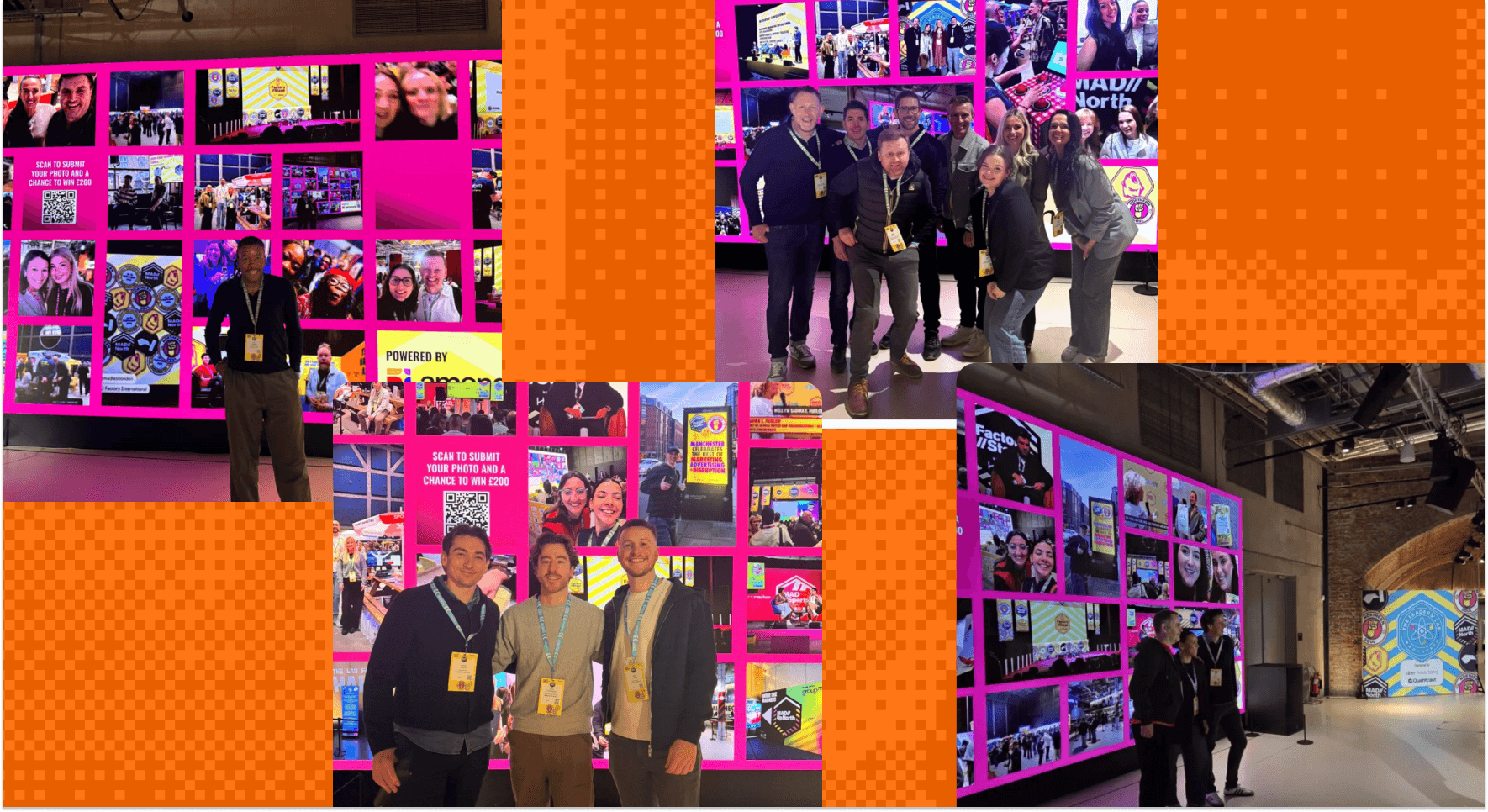
The more people see themselves reflected, the more they create. The more they create, the further MAD//Fest travels outside the room. It's a loop, and once it starts, it basically runs itself.
Give people a reason to participate and they will
But that loop only works if people have an easy way in. Turns out people want to be part of the experience. They just need someone to open the door for them.
At both MAD//North and MAD//Fest London, attendees could scan a QR code, submit their own photos and videos, and be in with a chance of winning a prize. Over 200 submissions came in across the two events. Every single one was rights-cleared and opted in.
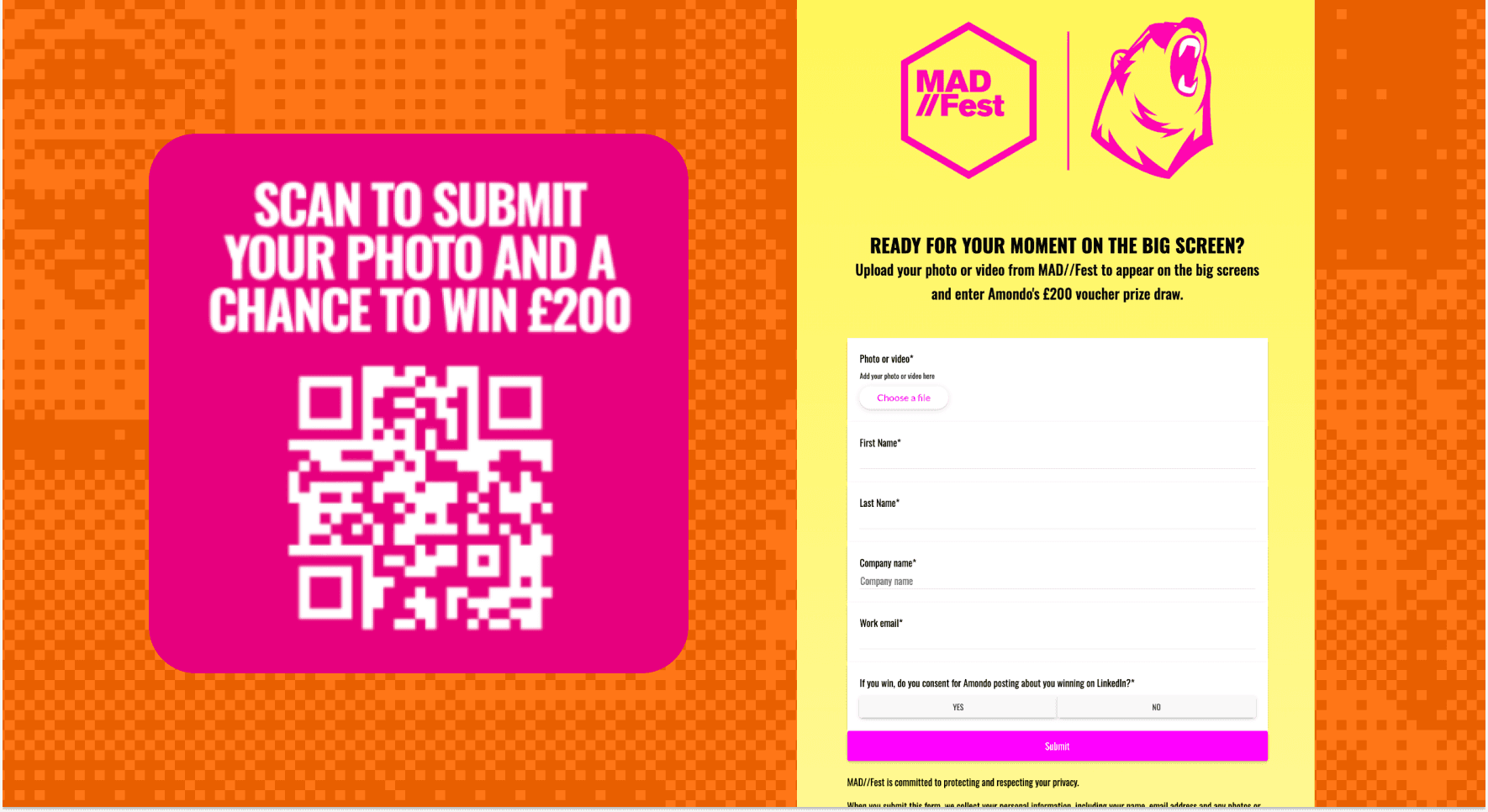
That's 200+ people who stopped, scanned, and handed over content and consent for nothing more than a QR code and the chance to win. Compare that to the usual event haul: a scatter of tagged posts you have to go digging for, most of which you'll never have the rights to reuse.
For MAD//Fest, those 200+ submissions became something a traditional setup never delivers: an owned, rights-cleared content library, plus a list of real people who've already said yes to hearing more. Not a moment that passed and disappeared. An asset that stays.
Content shouldn't end when the event does
What we're most excited about is what happened after the events.
After MAD//North, we built a carousel of the best moments from both days, which the team embedded on their website. Content that would normally have scattered across social feeds was now sitting on MAD//Fest's own platform, promoting the London event months before it happened.
For London, we went further. We built a microsite with highlight galleries for each of the three days, so attendees had a destination to revisit, which you can see here.
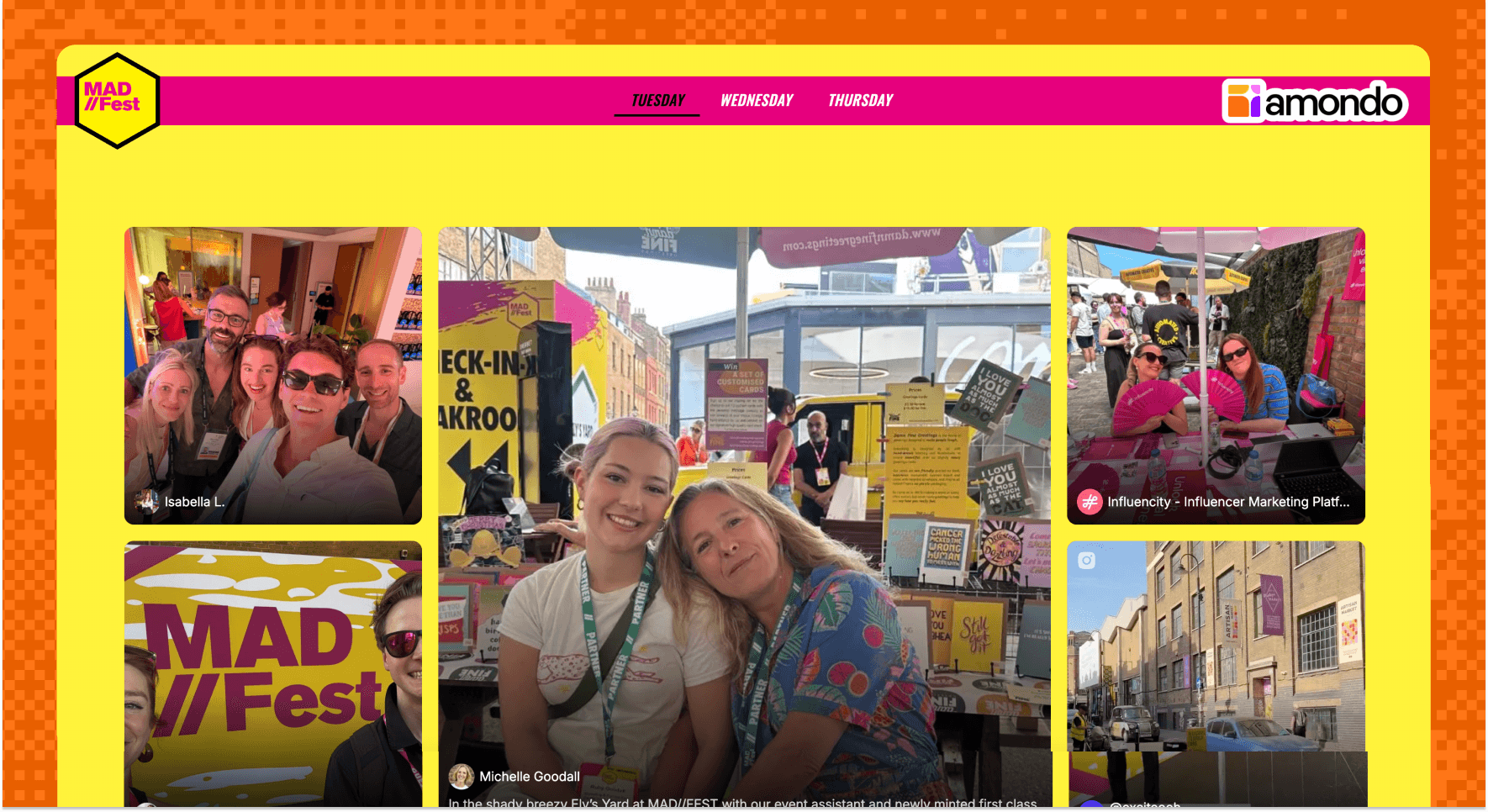
Within that same experience, we added our Reveal Tile, where visitors could see if they'd won a prize from Amondo. It's a small thing, but it gives people a reason to come back to the page and keeps the event alive in their minds well after they'd left the Truman Brewery.
Same pattern both times: capture the content during the event, then stretch its life out afterwards. Most events let that content vanish the second the last session wraps. MAD//Fest kept using theirs longer-term to drive excitement.
Giving stage sponsors real visibility
Each stage at MAD//Fest London had its own sponsor. Rather than the standard logo on a backdrop, we built sponsor branding straight into the Display experience, so when attendees were watching content on a stage screen, the stage sponsor's logo was sitting right there alongside it.
It's a lighter touch than a full branded takeover, but that's what makes it effective. The sponsor is associated with the content people are actually paying attention to, instead of competing with it for eyeballs.
What other events can take from MAD//Fest
Whether you're running a 500-person conference or a 15,000-person festival, some of the principles from what we built with MAD//Fest apply across the board.
Your screens are your most underused asset
Every attendee looks at them. If they're showing a holding slide, that's wasted attention. Putting real attendee content on those screens turns them from background noise into something people actively engage with.
People will participate if you make it easy
A QR code and a simple submission form are all it takes. Add a prize incentive and you remove the last bit of hesitation. MAD//Fest saw over 200 submissions across two events from people who were happy to hand over their content and their details.
Content has a longer life than you think
The photos and videos from your event don't have to vanish into social feeds. Capture them, curate them, and put them somewhere you own. MAD//Fest used post-event galleries and highlight carousels to keep promoting future events months after the last session had wrapped.
Give people a reason to come back after the event
A microsite with highlights is good on its own, but adding something interactive, like a prize mechanic, turns a passive gallery into an experience people want to revisit.
First-party data from events is massively undervalued
Every submission is a real person who engaged with your event, handed over their content with consent, and can now be reached directly. Use that: tell them when tickets go live, invite them back next year, follow up while the event's still fresh in their heads. Most events collect that audience and then let it go cold.
What's next
Working with MAD//Fest across both events this year reinforced something we keep seeing: when you make people feel like they're part of an event rather than just attending it, everything changes. They engage more, they create more, they remember more, and, crucially, they come back.
The combination of live screens, direct submissions, social curation, gamified web experiences, and post-event content galleries gave MAD//Fest a full end-to-end content experience that started before people even sat down and continued long after they left. From MAD//North in February to all eight stages at the Truman Brewery in July, the partnership has grown quickly because the value is clear on both sides.
"Our screens are usually just part of the backdrop, but Amondo completely changed that. Suddenly they became somewhere people wanted to be. You'd constantly see attendees pointing themselves out, dragging colleagues over and taking more photos because they knew there was a chance to appear on screen. It added a brilliant bit of energy to the event. Better still, the Amondo team handled everything, so it was effortless from our side. Seeing the impact it had made bringing them to MAD//Fest London an easy choice."
Steve Outridge
Marketing Director, MAD//Fest
If you're running events and your screens are still showing holding slides, your content disappears after the last session, and your sponsors are limited to logos on backdrops, there's a better way to do it. MAD//Fest proved that this year, twice.
Book a demo with the Amondo team here to learn how to elevate your own event content.
More from the blog


Ready to build something your audience will remember?
Bring your world of content into one connected content system - and make every piece work harder.
Trusted by brands that take content seriously