Tags
Sport
Published
Ready to activate your content? Talk to our team.
One of the biggest challenges for sports brands is the time between matchdays. Attention lapses, momentum declines, and performance becomes harder to uphold.
But non-matchdays aren’t a gap, they’re a unique opportunity.
When activated well, this period allows rights holders to drive meaningful fan actions such as signing up for memberships, purchasing merchandise, downloading apps, or planning future match attendance.
These moments reveal how fans actually behave, not just what they view or like.
By designing interactions around non-matchday moments — from membership sign-ups to buying merch — sports brands can uncover real signals of intent and preference, rather than relying on surface-level metrics.
So how do sports brands activate audiences between matchdays and turn behaviour into desirable intelligence?
We’ve identified five principles sports marketers should apply when designing content campaigns outside of matchdays to gain more insight into their fan base and drive commercial impact.
Tip 1: Design video to capture fan behaviour, not just fill inventory
Between matchdays, video is one of the most effective ways to keep fans engaged.
According to HubSpot’s 2024 video marketing data, short-form video is the most used format and delivers the highest ROI among marketers, with 83% reporting its effectiveness.
Short, bite-sized videos – such as fan-generated content, match clips, analysis, or behind-the-scenes footage – help extend the match narrative, fit naturally into modern attention spans and maintain momentum when there’s no live action.
Unlike static content, video demands time and attention. How long fans watch, what they skip, or whether they explore further are strong signals of interest that are far more meaningful than a like or impression.
The challenge is that this behaviour often lives on third-party platforms. This means that when a video is shared only on social media, most engagement insight remains inaccessible.
Putting video on your own website or app makes all the difference.
It lets you see how fans actually interact with content, so you can track and measure deep engagement, learning what drives fans to act, not just what they watched.
Takeaways
Video keeps fans engaged between matchdays and creates clearer signals of interest than static content
The real value of video lies in how fans engage with it, from what they watch, finish, and act on — not just who created it
Hosting video on owned channels and websites helps brands see what drives actions like ticket sales, merch, and sign-ups
Tip 2: Encourage fans to contribute to unlock better insight
Wyng (formerly Offerpop) found that while more than half of consumers are willing to interact with brand campaigns, only 16% of brands successfully turn that participation into first-party behavioural insight they can act on.
The opportunity isn’t just to spark interaction, but to invite fans to actively contribute beyond matchday.
Sports rightsholders have some of the most loyal fan bases, and they want to stay involved between fixtures, sharing opinions, creativity and personal moments that reflect their connection to the club or brand.
By inviting fans to submit content, opinions or experiences, rightsholders move beyond surface engagement.
Every submission becomes a source of first-party data, revealing who fans are, what motivates them, which players or themes resonate most, and how different audiences behave outside of matchday peaks.
The result is non-matchday campaigns that feel more genuine and community-led because they feature real fan voices.
At the same time, rightsholders gain a clear view of how audience behaviour and what drives them, helping to shape content and partner value without increasing output.
For their “Run Your Way” campaign, New Balance used Amondo’s social gallery and Submission Tile to give runners a simple way to take part.
Participants shared photos and videos of their runs via race hashtags or by uploading content, which surfaced in a branded wall on the event site.
This allowed New Balance to see which moments people chose to share and how community content performed compared to brand content, all based on real behavioural data, not surface metrics.
Takeaways
Fan participation drives intelligence, not just engagement
Brands can create more value without creating more content
This approach helps you to prioritise content decisions and partner activations based on behaviour, not guesswork
Tip 3: Create controlled content variation to generate behavioural insight
FC Nordsjælland used a deliberately different content perspective to observe how fans responded to a new format, topic and style compared to what they were used to for official club media.
In 2018, the club handed a GoPro camera to their intern, a 14-year-old fan. He interviewed players, including asking the club’s star striker why he wasn’t scoring goals…
By introducing a fan-led viewpoint inside controlled, branded formats, the club was able to compare behavioural responses – such as completion rates, replay behaviour and interaction patterns – against more traditional training and behind-the-scenes content.
This contrast helped reveal which types of storytelling drove deeper engagement from fans and sustained attention outside matchdays.
The value wasn’t the identity of the person holding the camera. It was the behavioural variation the format introduced, and the insight it generated into what non-matchday content actually resonates and holds attention.
Takeaways
Fan submissions add authenticity and community value, but the real advantage comes from experimenting with formats and observing behaviour to see what actually works
Varying content formats and access help rightsholders identify what drives non-matchday performance
Tip 4: Turn repeat fan behaviour into compounding intelligence
Non-matchdays aren’t only valuable because they create more content – they’re valuable because they create repeatable behavioural signals.
Using the same interactive formats over time encourages fans to return, making it easier to see clear patterns in behaviour; from content structures that drive deeper engagement andwhich access points prompt repeat interaction to which signals connect to downstream outcomes.
Over time, this behavioural data compounds.
Each activation adds context to the last, allowing brands to move from isolated performance snapshots to a clear understanding of what consistently works – and what to stop doing by proven behavioural drivers.
Takeaways
Repeatable activation creates behavioural data that compounds over time
Comparing signals across non-matchdays reveals what to scale, adapt or stop
Intelligence grows by reapplying learning, not recycling content
Tip 5: Activate audience content through measurable interaction formats
During the Tokyo 2020 Olympics and the coronavirus pandemic, Team GB faced a clear challenge: fan support was remote, fragmented and largely invisible beyond surface engagement metrics.
Using Amondo, Team GB brought together fan-generated content, athlete stories and branded partner content into a series of Amondo Galleries designed for engagement, participation and activation.
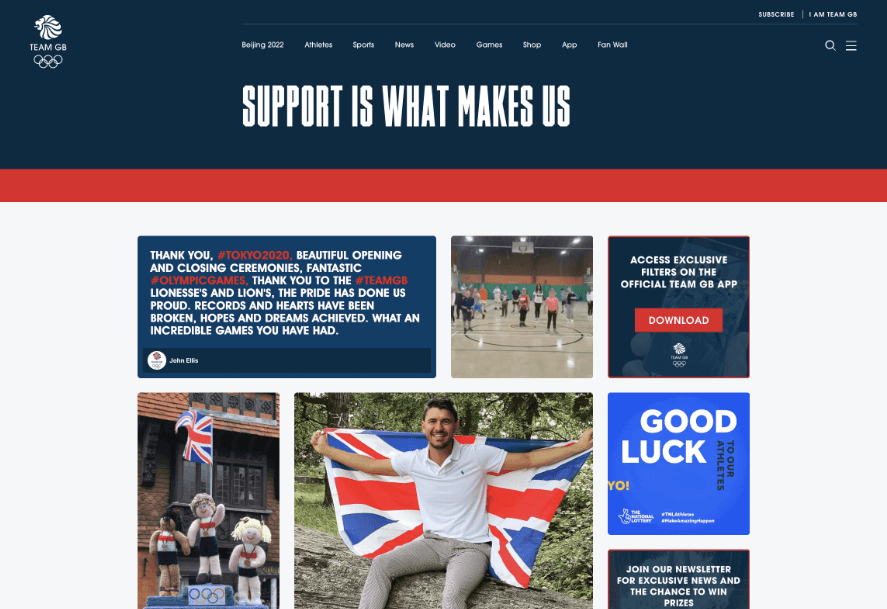
Amondo’s Submission Tile invited fans and athletes to share photos and videos with messages of support, creating a continuous stream of authentic content throughout the Games.
At the same time, embedded Click-Through Tiles turned attention into action, converting passive viewing into measurable interaction.

App and newsletter sign-up CTAs were placed at moments of high emotional connection, enabling Team GB to grow its owned audience and capture first-party behavioural data. This gave the team a clearer understanding of who its fans were, how they engaged with Olympic content, and how to continue those relationships beyond the Games.
The result wasn’t just visibility – it was behavioural intelligence. A repeatable model for understanding and activating fan support when attention is distributed, and physical presence isn’t possible.
Takeaways
Participation becomes intelligence
Interactive formats convert attention into measurable action, capturing behaviour that social platforms don’t expose
Behavioural insight enables long-term value, helping brands grow owned audiences and deepen engagement – even when physical presence isn’t possible
In summary
Non-matchdays are valuable because they allow sports brands to both publish more content and also create a repeatable opportunity to capture fan behaviour.
When fans interact with content through structured, portable formats, sports brands and rightsholders gain first-party behavioural insight into what holds attention, signals intent and drives outcomes between matchdays.
That insight compounds over time, replacing guesswork with clarity on what to prioritise, scale or retire.
The advantage isn’t fan-created content or curated feeds. It’s the ability to observe real behaviour, compare performance across formats and apply learning consistently as the season unfolds.
You can explore more examples in our case studies here.
More from the blog


Ready to build something your audience will remember?
Bring your world of content into one connected content system - and make every piece work harder.
Trusted by brands that take content seriously